[Article updated and reviewed 2015-11-15]
The complete download of the TESEO database has enabled the first analyses and verifications, from which several interesting data and insights have been obtained that are well worth sharing with the Spanish scientific community. The following statements are based on the collected information.
Initial results
The TESEO database contains 196,442 registered doctoral theses, with a total of 1,190,508 metadata records, implying that 994,066 are duplicates. Additionally, 7,857 doctoral thesis records lack the date of defense.
Based on the number of doctoral theses registered in TESEO, using the defense date as a reference, an overall positive growth trend is observed. It can be confirmed that the periods of greatest growth are concentrated in «1986–1987» with an increase of +2,260, «1989–1990» with +1,474, «1993–1997» with +2,694, and finally 2007–2014 with a growth differential of +4,061 newly registered works.
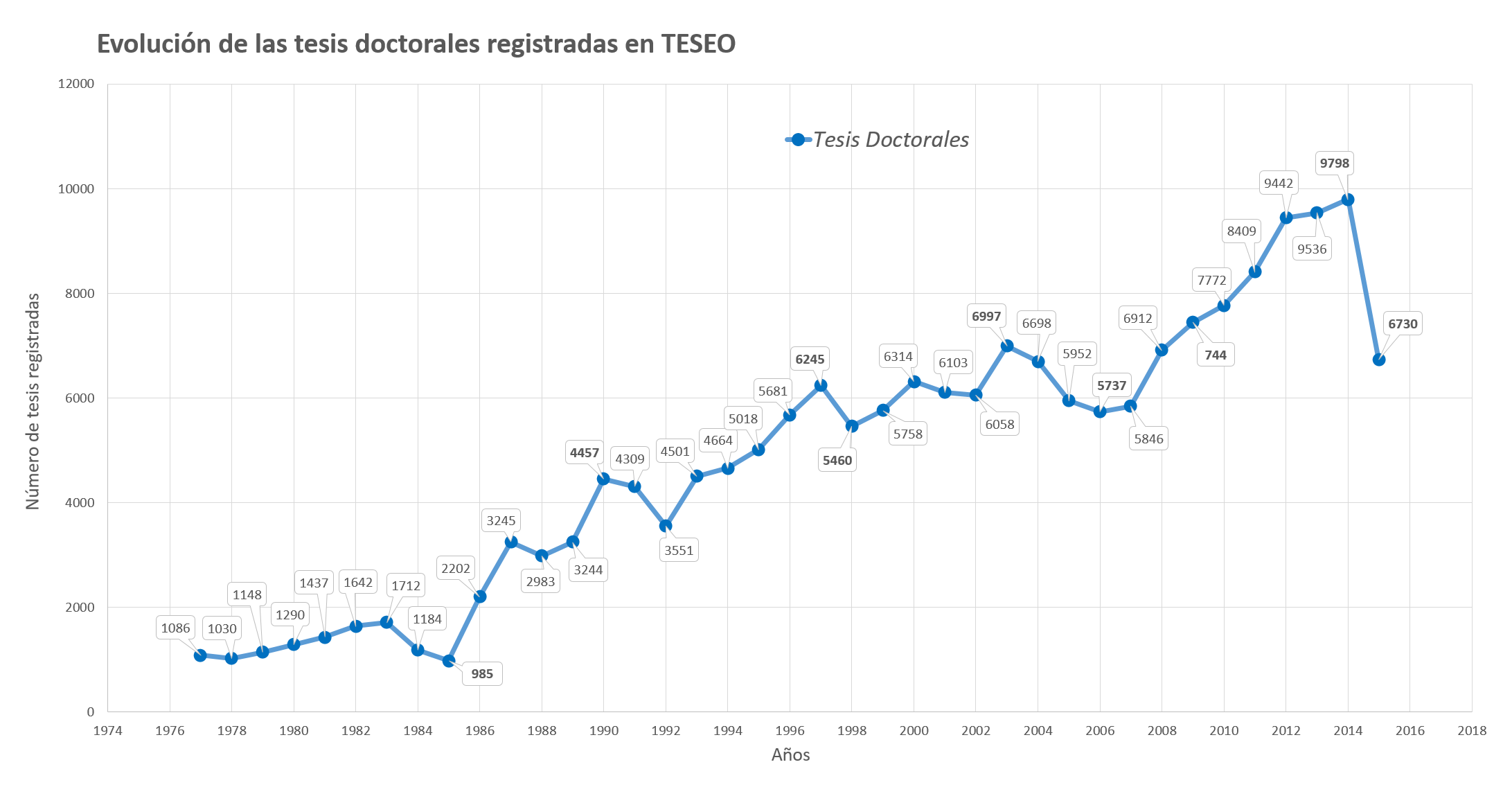
Fig.1. Evolution of the total number of doctoral theses registered in TESEO by year
The main milestones in the evolution of PhD Theses at Spanish universities are as follows:
The lowest result in the historical series occurred in 1985, with 985 registered Theses.
From 1985 to 1987, there was a significant increase of 2,260 works, reaching a total of 3,245 registered Theses.
In 1990, annual Theses reached 4,457, and from 1993 onward, a period of growth began, culminating in 1997 with 6,245 registered PhD Theses.
From 1997 to 2002, fluctuations occurred between 5,400 and 6,300 registered Theses, until 2003 reached the peak of 6,997 registered works.
In 2003, a slowdown in the number of Theses occurred, reaching its lowest point in 2006, followed by a continuous growth until 2014, surpassing all previous benchmarks with over 9,000 PhD Theses per year.
The year 2015 cannot be analyzed, as it is still within the active registration period of TESEO, and its data may vary significantly.

Fig.2. Differential growth in the number of PhD Theses
A detailed analysis of the period of greatest growth in the number of doctoral theses in Spain (2007–2014) reveals that the most prolific years were 2008 and 2012, which together account for 50% of the increase observed over the past eight years. A slowdown is also evident from 2012 to 2014, with a reduction in the rate of increase in doctoral theses.

Fig.3. Detail of the period 2004–2009
The possible factors that may explain the significant growth in the number of doctoral theses in Spain since 2007 include the following: 1) The reform of the Organic Law on Universities in 2007, enacted by Royal Decree 1393/2007 of October 29, which was implemented to align the higher education system with the Bologna Process within the European Higher Education Area. 2) The law stipulates that doctoral thesis work must be completed within a four-year period, which may have contributed to the largest increase recorded throughout the entire historical period. 3) The rise in the number of third-cycle students and the increasing number of universities in Spain likely contributed to the growth observed in the TESEO data. 4) Efforts toward the internationalization of Spanish universities may be responsible for the increased number of foreign students coming to conduct research in the country. 5) Based on the available data, it cannot be asserted that the economic crisis has interfered with the growth of doctoral theses. Nevertheless, additional data would be required to definitively rule out this hypothesis.
- Data file – teseo-analisis-cronologico
List of TESEO articles